Key Takeaways
1. Fleet expenses tracked without changing how drivers work. Hopcharge's operators kept doing their jobs the same way. The only difference is that payments now go through a CashBook UPI wallet instead of cash.
2. Fuel and toll expenses tracked automatically. The majority of merchant payments go to gas stations and toll plazas. CashBook replaced the old "hand cash to the driver" model with UPI payments that are logged the moment they happen.
3. P2P payments made visible for the first time. Most of Hopcharge's daily spending goes to individuals, like roadside mechanics, parking attendants, and helpers. These payments have no merchant receipt. CashBook captures them through UPI, making previously invisible expenses fully trackable.
4. Working capital exposure dropped significantly. Only a few operators carry a wallet balance at any time. The company's money is not sitting idle in pockets across the city.
5. Went live in two days, committed long-term. Hopcharge moved from account creation to active payments within 48 hours and have been using CashBook Wallets to manage expenses for over an year now.
About Company
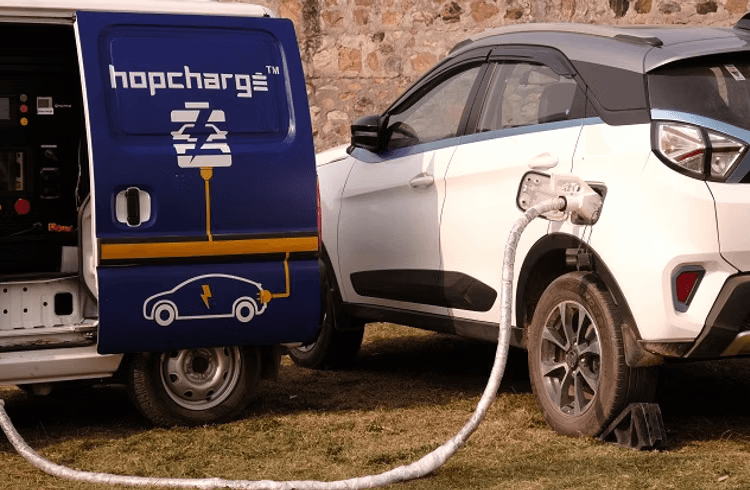
Hopcharge is a Gurugram-based EV startup that built India's first doorstep electric vehicle charging service. Instead of making EV owners drive to a charging station, HopCharge sends a mobile charging van to the customer's location, whether that's their home, office, or anywhere else.
The company was founded in 2019 by Arjun Singh and Saurabh Rohilla. Their fleet of charging vans carries patented battery packs and rapid chargers that can fast-charge any EV on the spot. HopCharge currently operates across Delhi-NCR, covering Delhi, Gurugram, Noida, and Faridabad, and works with partners like Tata Motors, Mercedes-Benz, and Acko.
The business model is simple from the customer's side. But from an operations perspective, running a fleet of mobile vans across a metro region creates a unique challenge. Every van, every driver, every trip generates small expenses. Fuel for the van, tolls on the highway, parking at the customer's building, a quick repair on the road. These are small amounts individually, but they add up fast across the entire fleet.
Managing these daily fleet expenses is what brought Hopcharge to CashBook.
Challenges
What fleet expense challenges did Hopcharge face?
Hopcharge's operations are different from most businesses. There is no central office where everyone shows up, spends company money, and submits bills at the end of the day. The entire team is on the road, spread across different parts of Delhi-NCR, making on-demand trips to customer locations. This created a set of driver expense management problems that got harder as the fleet grew.
Drivers paid from personal funds daily
Operators regularly used their own money for fuel, tolls, and parking during trips. Getting reimbursed took days, sometimes longer. This created frustration and cash flow stress for the team.
No way to track fuel and toll spending
Fuel and toll charges are the two biggest recurring costs for any fleet business. But with cash-based payments, there was no structured data on how much each operator spent on fuel per day, or which routes had the highest toll costs. Everything was estimated, not tracked.
P2P payments were completely invisible
A large portion of daily spending went to individuals like roadside mechanics, car wash workers, parking attendants, and local helpers. These people do not have POS terminals or merchant accounts. There was zero digital trail for these payments, making them impossible to verify or audit.
Receipts lost before reaching finance
Paper receipts from fuel stations and toll booths would get crumpled in the glove box, faded in the heat, or simply forgotten. By the time they reached the finance team, many were missing or unreadable. Reconciling actual expenses against what was reported became guesswork.
Cash advances created idle float risk
The traditional approach was to give each driver a cash advance at the start of the week. This meant company money was spread across multiple operators with no visibility into whether it had been spent, how it was spent, or how much was left.
For an EV startup working with partners like Tata Motors and backed by investors who expect clean financial data, this level of ambiguity in fleet expense management was not sustainable.
Solutions
How CashBook solved Hopcharge's fleet expense problems
Hopcharge adopted CashBook in early 2025 and went from account creation to active payments in just two days. The speed mattered because every day without a system meant another day of untracked spending across the fleet.
Here is what changed:
Company-funded UPI wallets for every driver
Each operator received their own CashBook UPI wallet, loaded remotely by the finance team. No more cash envelopes, no more ATM runs, no more asking drivers to come to the office to pick up money. Wallets were sized to cover a week or two of field expenses, keeping the float small and controlled.
Fuel and toll payments tracked automatically
Every fuel station payment and every toll charge now goes through the operator's CashBook wallet via UPI. Each transaction is logged instantly with the merchant name, amount, date, and operator identity. The finance team can now see fuel expense tracking data per driver, per day, per route, something that was never possible with cash.
P2P payments captured through UPI
When an operator pays a roadside mechanic or a parking attendant, that payment also goes through the CashBook wallet. The recipient's UPI ID, the amount, and the timestamp are all recorded. This turned the biggest blind spot in Hopcharge's expenses, payments to individuals, into fully auditable transactions.
Real-time dashboard for finance team
Instead of waiting for weekly receipt submissions, the finance team now has a live dashboard showing all spending as it happens. They can see who is spending, where, how much, and in which category, whether it is fuel, tolls, government transport fees, or P2P payments.
Full KYC for all field operators
Every operator on Hopcharge's CashBook account completed identity verification. This means every wallet and every transaction is tied to a verified person, supporting GST compliance and creating the kind of audit trail that investors and partners expect.
CashBook gave Hopcharge something they had never had before: a single system that handles both merchant payments and person-to-person payments, tracks fuel and toll spending by operator, and gives the finance team complete visibility without slowing down the people doing the work on the ground.
Impact
What changed after Hopcharge started using CashBook?
The results showed up quickly. Within weeks, the way money moved through Hopcharge's operations looked completely different.
Every fleet transaction now digitally recorded
Thousands of small expenses that previously disappeared into cash and lost receipts are now tracked. Each transaction has a digital record with the operator's name, the recipient, the amount, and the time.
Fuel and toll data became a fleet optimization tool
For the first time, Hopcharge's finance team can see exactly how much each operator spends on fuel and tolls per day. This data answers questions that matter for a fleet business: Which routes cost the most to serve? Are some operators spending more on fuel than others for similar trips? Are toll costs proportionate to the number of charging appointments completed?
Working capital exposure dropped sharply
With cash advances, company money was scattered across every driver's pocket with no visibility. Now, only a handful of operators carry a wallet balance at any time. The total amount sitting in wallets at any given moment is minimal compared to what it used to be under the old system.
Finance team freed from chasing receipts
The old process of collecting paper receipts, matching them to expenses, and entering data into spreadsheets is gone. The dashboard does the work. Expense reconciliation happens in real time, not at month-end.
Operators stopped using personal money
Drivers no longer need to pay for fuel or tolls from their own pocket and wait for reimbursement. They spend from the company wallet directly. This removed a major source of frustration for the field team.
The most important outcome is that Hopcharge now has a mobile workforce expense management system that works at the pace of their operations. As they add more vans and expand to more cities, the system scales with them. Adding a new operator means creating a new wallet. That is it.
Industry Application
How CashBook helps EV and fleet businesses manage on-road expenses
Hopcharge's challenges are not unique to one company. Any business that runs a fleet of vehicles, whether it is EV charging vans, delivery bikes, service vehicles, or logistics trucks, faces the same core problem: drivers spend money on the road every day, and the finance team has no good way to track it.
The spending pattern is also similar across all fleet businesses. Fuel, tolls, and payments to individuals (mechanics, helpers, parking) make up the bulk of daily expenses. Traditional expense management software built for office workers does not capture any of this properly.
CashBook is built for exactly this kind of on-road, high-frequency, small-value spending. Here is how different fleet and field businesses benefit:
EV Charging and Clean Mobility
Track fuel, tolls, and on-road costs for mobile charging fleets with per-operator visibility.
Last-Mile Delivery and Logistics
Give riders and drivers company-funded wallets for fuel and daily expenses instead of cash advances.
Field Service and Maintenance
Equip technicians with tracked wallets for spare parts, tools, and transport costs at customer locations.
Transportation and Bus Operators
Manage driver expense tracking for fuel, tolls, permits, and vehicle maintenance across routes.
Agricultural Field Operations
Track expenses for field agents visiting farms, including fuel, meals, and small vendor payments.
Doorstep Service Startups
Any on-demand service business with a mobile workforce can use the same wallet-based expense model that works for Hopcharge.
The pattern that Hopcharge proved is simple: if your team spends money on the road, CashBook tracks it. Fuel stations, toll plazas, government transport offices, roadside mechanics, parking attendants. All of it, through one wallet, visible in one dashboard.
For similar field operation challenges in construction, see how RDash manages site-level expenses. For multi-city distributed teams, see how HelloWorld scaled expense management across 19 cities. For renewable energy companies with teams moving between project sites, see how Heaven Green Energy used CashBook to go 90% cashless.
Conclusion
Hopcharge’s story is proof that fleet expense management does not need to be chaotic. A mobile EV charging company with operators spread across Delhi-NCR, making dozens of fuel stops, toll payments, and P2P transactions every day, now tracks every single rupee digitally through CashBook.
Related customer story: GPS Renewables manages multi-site CBG plant expenses with CashBook UPI wallets.