Key Takeaways
HelloWorld manages 10,000+ beds across 19 cities with distributed field teams
Manual reimbursements and cash advances created reconciliation backlogs
CashBook replaced cash with company-issued UPI wallets and admin-set limits
Finance gained real-time visibility into all field-level spending instantly
Reconciliation effort dropped by 60%, reimbursement delays by 70%
About Company
When Scale Outgrows Spreadsheets
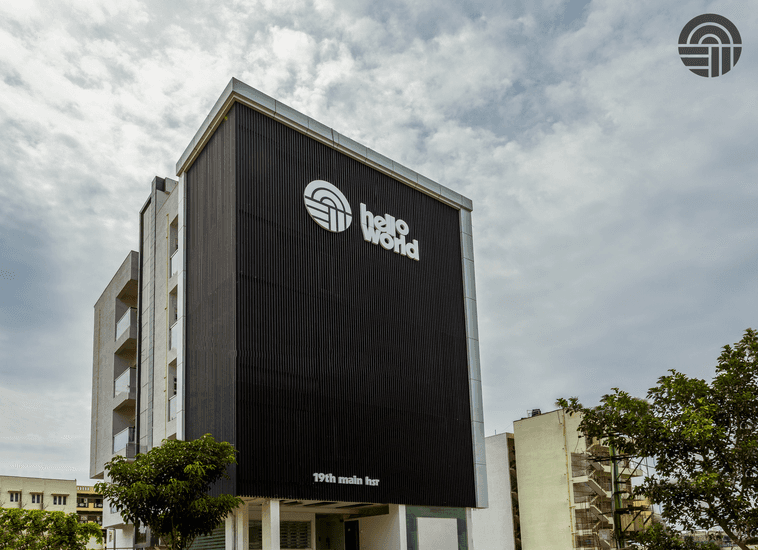
HelloWorld Technologies is one of India's fastest-growing co-living and student housing brands. Launched in 2021 as an independent subsidiary of NestAway, HelloWorld was built to serve students and young professionals seeking affordable, community-driven living spaces across Indian cities.
The company operates an integrated model , leasing large residential properties and transforming them into fully managed shared homes offering furnished rooms, meals, housekeeping, Wi-Fi, and community engagement. With over 10,000 beds under management and presence across approximately 19 cities, HelloWorld sits at the intersection of real estate, hospitality, and technology.
But rapid expansion created a challenge that no spreadsheet could solve.
Managing properties at scale meant coordinating vendor payments, maintenance expenses, staff travel, utility bills, SaaS subscriptions, and daily procurement , all happening simultaneously across dozens of locations. With distributed operational teams on the ground and a central finance team overseeing everything, HelloWorld needed a smarter way to manage employee petty cash and field-level spending without losing control.
For a margin-sensitive business like co-living, financial discipline is not a back-office function. It is a core operational strategy.
Challenges
Managing Multi-City Operations With No Real-Time Expense Control
As HelloWorld expanded city by city, the volume and complexity of operational spending grew in parallel. Every property required regular payments , housekeeping vendors, food service providers, maintenance contractors, utilities, and local procurement. At the same time, corporate teams were managing travel bookings, software subscriptions, and administrative costs.
The company's existing approach relied on manual reimbursements, cash advances, and spreadsheet-based tracking. What worked at an early stage became a serious bottleneck at scale. Finance teams were constantly reconciling past transactions instead of monitoring current ones. Approval cycles were slow. Reporting was delayed. Budget forecasting was uncertain.
For a business with teams spread across 19 cities, this was not just an inconvenience , it was a structural risk.
No real-time visibility into what employees were spending across locations
Heavy dependence on cash advances for site teams and manual reimbursement cycles
Decentralized, unstructured spending with no consistent policy enforcement
Slow approval workflows causing vendor payment delays and strained relationships
Complex month-end reconciliation with high transaction volume and missing receipts
Finance teams spent more time on administrative follow-up than on treasury planning. The lack of structured controls also made it difficult to prevent duplicate bill payments , a common risk when multiple employees manage similar vendor relationships across properties.
For a distributed operations business like ours, financial visibility and spend control are fundamental to maintaining discipline at scale. CashBook has helped us transition from manual, reimbursement-driven processes to a more structured and policy-led expense framework across multiple cities.
- Aju Philip George
Senior Finance Director
Solutions
CashBook UPI , Built for Distributed Operations
CashBook UPI was designed precisely for businesses that operate like HelloWorld , distributed teams, high transaction frequency, multiple vendor relationships, and a finance function that needs centralized visibility without slowing down ground-level operations.
Rather than relying on cash advances or delayed reimbursements, CashBook enables businesses to issue controlled digital wallets to employees. Every payment is made via UPI, with receipts captured at the point of transaction , eliminating the paperwork chase at month-end. For HelloWorld, this approach replaced fragmented manual processes with a centralized, policy-driven expense infrastructure.
Instant Employee Wallet Issuance with Predefined Spend Limits
UPI-Based Expense Management for Field Teams
Automated Reconciliation and Accounting Integration
Contactless, Audit-Ready Payments for On-Ground Staff
With CashBook UPI in place, HelloWorld moved from a reactive, reimbursement-driven model to a proactive, wallet-based spend infrastructure. Treasury teams could top up wallets in bulk while maintaining full balance visibility. Managers could approve vendor payments in real time. Finance received structured, categorized, audit-ready data , without manual consolidation.
This was not a change in how HelloWorld operated on the ground. It was a transformation in how the company saw and controlled what was happening on the ground.
The wallet-based approach with defined limits and real-time tracking has significantly improved our ability to monitor field-level spends, enforce financial controls, and manage budgets proactively. At the same time, it has enabled faster execution for our on-ground teams without compromising governance.
- Aju Philip George
Senior Finance Director
Impact
Visibility, Speed, and Financial Discipline at Scale
When CashBook UPI went live across HelloWorld's operations, the results were not incremental. They were structural.
The finance team shifted from chasing receipts and consolidating spreadsheets to monitoring live dashboards and generating reports on demand. Expense review cycles that once stretched across weeks were cut in half. Reimbursement-related delays , a persistent friction point for field staff , dropped by close to 70%.
Most significantly, HelloWorld now had what fast-growing co-living brands rarely possess: real-time financial clarity across 19 cities, without a proportional increase in finance headcount.
Overall, CashBook has been a valuable partner in strengthening our operational efficiency and financial oversight as we continue to scale.
- Aju Philip George
Senior Finance Director
For Finance Teams: Month-end reconciliation became a structured, data-driven process instead of a manual scramble.
For Property Managers: Vendor payments happened faster. Approvals no longer required email chains or offline coordination.
For Leadership: Budget discipline improved across the board.
For the Business: HelloWorld built a financial infrastructure designed to scale.
Co-living brands face a unique operational challenge. They combine the financial complexity of real estate management, the vendor intensity of hospitality operations, and the workforce distribution of a field-service business , all under one roof.
This makes them among the most demanding use cases for expense management. Traditional tools built for office-based teams or single-location businesses don't hold up. What co-living brands need is a low-cost expense tracking solution for a distributed workforce , one that handles high transaction volumes, enforces spending policies by location, and gives finance teams a live view of every rupee in motion.
CashBook was built for exactly this environment.
Whether the need is managing daily procurement expenses, settling vendor invoices on time, tracking utility payments across properties, or giving field staff a reliable alternative to cash advances , CashBook provides the infrastructure to do all of it with structure, speed, and visibility.
Industry Application
The HelloWorld model translates directly to other industries managing distributed teams and multi-location operations:
Co-Living & PG Brands
Real-time management of multi-property operational expenses with outlet-level expense control and vendor payment tracking across cities.
Construction & Real Estate
Controlled employee wallets for site-level spending, replacing cash advances for site teams and enabling structured procurement tracking.
Hospitality & Hotels
Daily vendor, travel, and maintenance payments with receipt capture and real-time reconciliation , a practical alternative to petty cash for hotel operations.
Retail Chains
Store-level expense control with spend limits by role and location, giving central finance teams visibility across every outlet.
Logistics & Transportation
Fuel, toll, and driver-related operational cost tracking with contactless payments for delivery teams in India.
Event Management
High-frequency vendor payment management during live events, with instant approvals and on-the-spot receipt capture.
Structured Spend, Scalable Growth
HelloWorld's story is one that many fast-growing Indian businesses will recognize.
You expand rapidly. Your teams do their jobs well. But the financial infrastructure underneath starts to crack under volume. Reimbursements pile up. Reconciliation takes weeks. Finance spends more time on paperwork than planning.
The answer is not to slow down growth. The answer is to build the right expense infrastructure before the friction becomes a ceiling.
By adopting CashBook UPI, HelloWorld replaced manual reimbursements and fragmented tracking with a centralized, policy-driven system that works at the pace and scale of its operations. Finance gained real-time clarity. Field teams got faster payments. Leadership gained the confidence to plan treasury flows without guesswork.
Book a demo to see how the same expense management setup used by HelloWorld can help your distributed teams manage multi-city operational expenses with real-time visibility and control.