Key Takeaways
R-Dash uses CashBook to manage daily site and field expenses made by its teams during construction-related work.
Earlier, site teams had to use cash or personal UPI to make urgent payments, which caused reimbursement delays, missing bills, and confusion for the finance team.
CashBook helped R-Dash move to company-funded UPI payments, so teams could pay directly for site expenses without using their own money.
Each payment was recorded instantly with a bill photo and location, giving clear visibility to finance and management.
This made expense tracking simple, reduced follow-ups, removed reimbursement problems.
Here’s what RDash’s founder shared about their experience with CashBook: CashBook X RDash
About Company
RDash is a B2B SaaS company focused on helping construction and interior businesses manage project execution, coordination, and operational workflows. Its platform enables customers to plan real estate projects, track progress, manage procurement, and maintain visibility across multiple construction sites and stakeholders.
Before becoming a standalone construction-tech SaaS company, RDash originated as an internal operating system for a construction execution business called 91 Square Feet. Under this build-and-execute model, the team directly handled construction projects, site operations, vendor coordination, and on-ground execution across multiple locations.
Operating at construction sites, client locations, and vendor offices was core to the business. Successful execution depended not only on planning, but on how smoothly teams could function on the ground. This environment made expense management a daily operational requirement rather than a back-office task.
As the internal tool matured and proved its value in live projects, RDash was later spun out as an independent SaaS platform, built from real-world construction execution experience.
Operating Reality: On-Ground Teams and Real-Time Spend
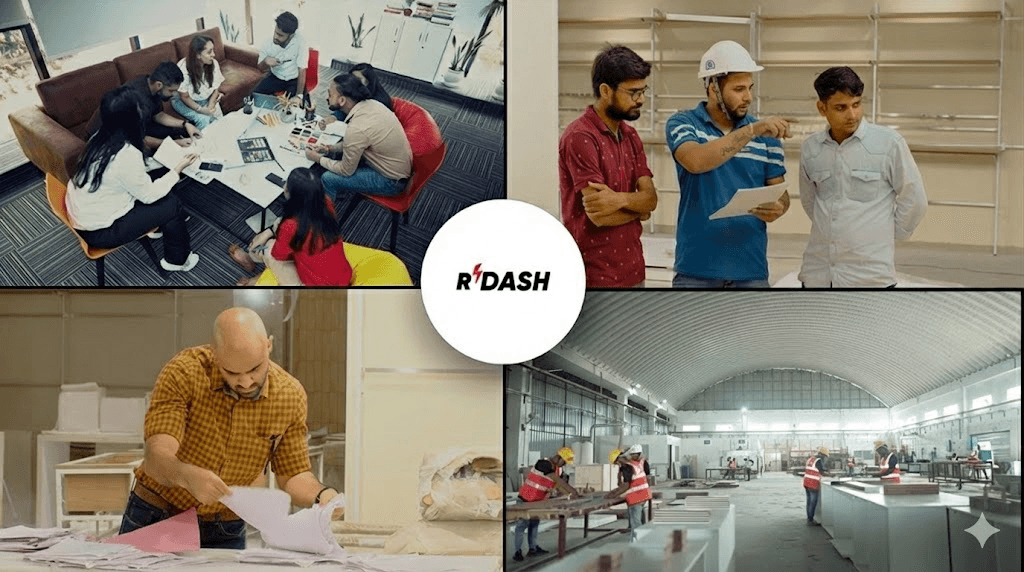
Both during its time as 91 Square Feet and later as RDash, the company operated with a hybrid structure. Product, engineering, and central operations teams worked from offices, while sales, implementation, and customer success teams spent a significant amount of time in the field.
These teams travelled frequently to construction sites, interior fit-out locations, design studios, and client offices. They conducted demos, onboarding sessions, training sessions, and on-site problem resolution. This made on-ground execution a critical part of daily operations.
Naturally, a large portion of business expenses occurred outside the office, often in fast-moving and unpredictable situations. How these expenses were managed had a direct impact on execution speed, employee experience, and scalability.
Challenges
Challenges in Managing Site-Level Expenses
As RDash scaled its construction-focused operations, on-ground expenses became frequent and unavoidable. Site teams needed to make immediate payments to keep work moving. These included travel, meals, local transport, printing drawings, site materials, and client-related costs.
Formal approval workflows or delayed purchase processes were not practical at construction sites. To avoid slowing down work, employees often paid using cash or their personal UPI accounts and submitted reimbursement requests later.
At an early stage, this approach appeared manageable. However, as operations expanded, gaps in the process became clear.
During this phase, RDash faced recurring challenges in managing site-level expenses:
Employees regularly paid business expenses from personal funds
High volume of small, urgent expenses
Limited visibility into site-level spending
Bills were frequently lost or submitted late.
Manual verification and batch processing delayed payouts and increased administrative load
As project volume increased, these issues became structural. Finance teams spent disproportionate time reconciling claims.
Managers reacted to problems after they occurred. Leadership recognised that this was not solvable through minor process tweaks.
Solutions
How RDash Managed Construction Site Expenses Using CashBook
When RDash evaluated its expense workflows, one conclusion stood out. Expenses were happening in real time, but systems were designed to manage them much later. This disconnect was at the root of most operational friction.
RDash needed a solution that aligned with how sales, implementation, and customer success teams operated on the ground. Employees needed access to company funds at the moment of spending. Finance teams needed visibility and control without slowing execution. Leadership needed confidence that the system would remain effective as the organisation grew.
CashBook enabled RDash to shift from a reimbursement-based model to a company-funded, real-time expense system.
How CashBook Was Implemented at RDash
Company-funded UPI wallets for employees: On-ground teams used CashBook UPI wallets to spend company money directly for business expenses.
Instant payments without operational delays: Employees paid for travel, meals, printing, and client needs without waiting for prior approvals.
Simple post-spend documentation: Bills were uploaded immediately after each transaction, keeping records timely and accurate.
Automatic capture of transaction location: Each payment recorded its location, helping verify that expenses matched the relevant site or client visit.
Real-time visibility for finance teams: Finance teams monitored spending live, set limits, and simplified reconciliation without repeated follow-ups.
From Internal Tool to SaaS: Why RDash Trusts CashBook
As RDash was spun out from 91 Square Feet into a standalone construction-tech SaaS platform, the leadership team carried forward lessons from its execution experience.
The team had already used CashBook in real construction environments and had seen how company-funded UPI wallets reduced friction, improved visibility, and removed reimbursement-related challenges for site teams.
Because of this firsthand experience, RDash developed a clear understanding of the operational value CashBook provides to construction and field-driven businesses.
Today, RDash continues to use CashBook as its expense management layer based on its effectiveness in live construction operations. This reflects a strategic alignment built on shared on-ground realities.
Impact
The use of CashBook brought clear and visible changes to how site expenses were handled. Earlier, bills were submitted days or even weeks after the expense was made. With CashBook, bill submission happened within hours of payment, while the work was still fresh. This improved accuracy and reduced missing bills. Since all payments were made through company UPI wallets and tracked in real time, transparency increased and cash leakage reduced significantly. Finance teams had better control over site expenses, and site teams no longer needed to manage cash or worry about reimbursements.
Before CashBook, energy was consumed by tracking past expenses, chasing bills, resolving discrepancies, and processing reimbursements. After implementation, much of this overhead disappeared.
Operational Improvements Observed
Reduced follow-ups on expenses: Bills were captured close to the time of transaction, reducing the need for repeated follow-ups.
Faster and predictable reconciliation: Finance teams worked with structured, real-time expense data.
Lower managerial overhead: Managers relied on visibility and spending limits instead of manual checks.
Improved employee experience: Teams no longer needed to pay upfront or wait for reimbursements.
Early detection of anomalies: Location-linked expenses helped identify incorrect or unusual spends early.
The most important outcome was confidence at scale.
Expense management stopped being a fragile, reactive process. It became a stable operational layer that supported growth during RDash’s execution-led phase and as a SaaS company serving similar businesses.
Finance moved from firefighting to proactive control. Employees felt trusted. Leadership scaled without concern.
Industry Application
While this case study focuses on how Rdash uses CashBook to manage on-ground business expenses, the underlying challenge is not unique to one company or one sector. Any industry with mobile teams, frequent small expenses, and delayed reimbursements faces similar friction. CashBook is designed to solve this problem at the system level, not just for one use case.
Here are six industries where CashBook is especially effective, along with the key value it delivers in each.
Construction and real estate developers
Instant site payments with central visibility.
Interior design and fit-out companies
Fast site and vendor spends without cash.
Contractors and execution firms
Simple petty cash tracking across sites.
Facility management companies
Daily operations expenses with control.
Retail rollout and infrastructure teams
Smooth multi-location spending.
Field sales and customer success teams
Travel and client expenses without reimbursements.
Conclusion
RDash’s journey from executing construction projects under 91 Square Feet to becoming a construction-tech SaaS platform highlights a simple truth.
When expenses happen in real time but are managed later, friction is inevitable.
By adopting CashBook early in live construction environments, RDash solved this problem at its root. Expense management became real-time, structured, and scalable, supporting both execution and software growth.
That is why CashBook is not just a tool Rdash recommends, but one it trusts enough to integrate with as a long-term partner.
This is the kind of operational foundation modern, on-ground businesses need to scale with confidence.
Book a demo to see how the same expense management setup used by RDash can help your teams manage site-level spending with better visibility and control.