
Your field team member usually spends ₹500 from one location. Today, a ₹2,200 charge shows up from a completely different city. No receipt attached. No explanation. By the time finance notices, the month-end close is already done.
This isn't a hypothetical scenario. It comes directly from conversations with Indian business owners who switched to controlled expense systems after getting burned by exactly this kind of spending anomaly. Cash pilferage and expense padding are among the most emotionally charged problems in business finance - and for good reason. The losses are real, recurring, and almost always preventable.
This guide answers every question Indian business owners and finance teams ask about employee expense fraud - what it looks like in practice, why it keeps happening, and the specific controls that actually stop it.
TL;DR - What this guide covers
Employee expense fraud costs Indian businesses 5% of yearly revenue on average.
Field teams, site crews, and on-ground staff are the highest-risk areas because of heavy cash use and weak tracking.
Manual reimbursement systems make fraud easy because there is a long gap between spending and review.
The fix is not stricter policing - it is changing how money flows.
Company-funded UPI wallets with GPS tagging, receipt mandates, category locks, expense categorisation and real-time dashboards prevent fraud at the point of payment, before money moves.
This guide covers the most common fraud patterns in Indian businesses, why manual systems fail, 7 controls that work, how UPI wallets solve this by design, industry-specific examples, and a 10-point checklist to audit your current process.
What is employee expense fraud, and why is it so common in Indian businesses?
Employee expense fraud is the deliberate manipulation of business expense claims for personal gain. It includes submitting inflated bills, creating phantom receipts, claiming personal purchases as business costs, and filing the same expense more than once for reimbursement.
In India specifically, this problem runs deeper than most companies realize. Research from the Association of Certified Fraud Examiners estimates that organizations lose roughly 5% of annual revenue to occupational fraud, with expense reimbursement schemes appearing in 13% of all reported cases. The median loss per scheme sits around ₹42 lakh ($50,000) annually, and most cases run for 18 months before anyone detects them.
What makes Indian businesses particularly vulnerable is the heavy reliance on cash. On-ground teams in construction, logistics, retail, and field sales handle physical currency daily. When a site supervisor gets a ₹10,000 cash advance to pay carpenters and buy materials, there is often no verifiable trail linking what was handed out to what was actually spent. The gap between advance and settlement is where pilferage thrives.
The other factor is the reimbursement model itself. When employees pay from their personal accounts and submit claims weeks later, the company has no way to verify the transaction in real time. A receipt photo on WhatsApp becomes the only "proof," and finance teams processing hundreds of these monthly simply cannot catch every inflated bill or duplicate submission.
What does expense fraud actually look like for field teams and on-ground operations?
Most content about expense fraud focuses on corporate travel - padded hotel bills and first-class upgrades. That is not the reality for the vast majority of Indian businesses. The fraud that bleeds Indian businesses dry happens at the ground level, in ₹200 and ₹500 increments, every single day.
Here are the patterns that come up repeatedly in conversations with businesses across construction, logistics, retail, and field services:
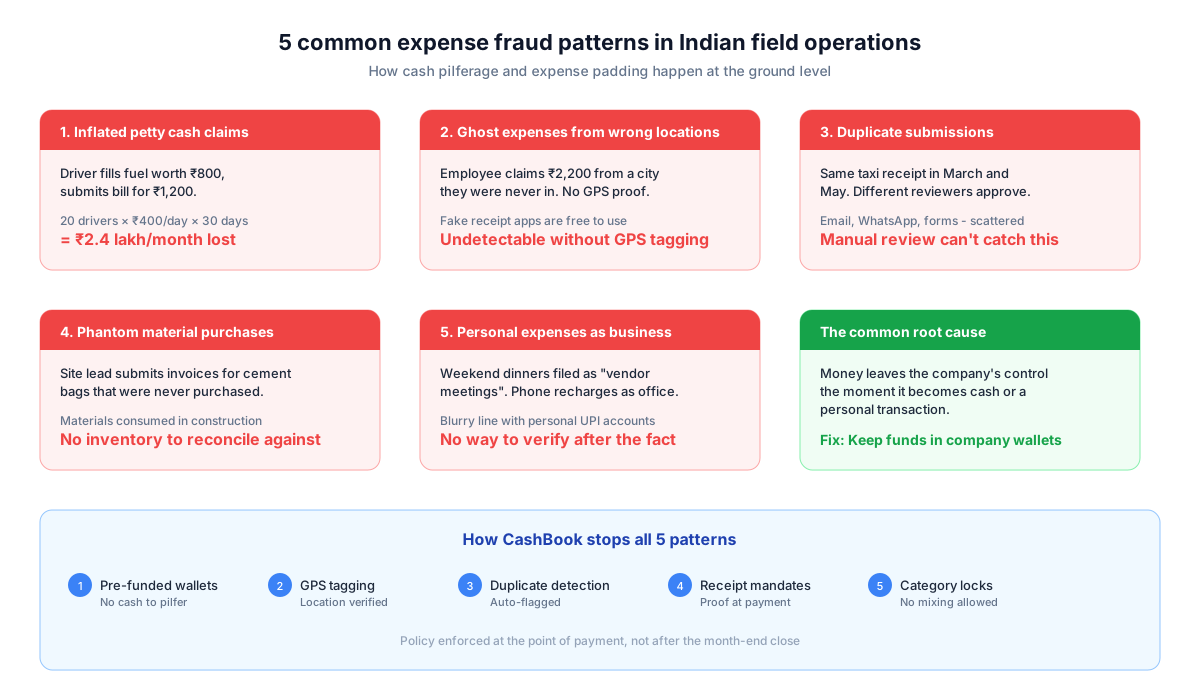
Inflated petty cash claims. A route manager fills fuel worth ₹800 but submits a bill for ₹1,200. The difference is small enough that nobody questions it, but across 20 drivers and 30 days, the monthly leakage reaches lakhs. This is the single most common form of cash pilferage in small businesses.
Ghost expenses from unverifiable locations. A field executive claims ₹2,200 in "client meeting expenses" from a city they were never in. Without GPS verification, the only evidence is a receipt that could have come from anywhere - or been generated using one of the dozens of fake receipt apps available for free.
Duplicate submissions across reporting periods. The same taxi receipt appears in March and again in May, submitted through different channels (once on email, once on the expense form). In a company processing expenses manually, this sails through approval because different people review each cycle.
Phantom material purchases on construction sites. A site crew lead submits invoices for cement bags or hardware supplies that were either never purchased or purchased at lower quantities. The materials are consumed during construction, so there is no physical inventory to reconcile against.
Personal expenses disguised as business costs. Weekend family dinners filed as "vendor meetings," personal phone recharges listed under "communication expenses," and personal travel mixed in with client visits. These are not always calculated fraud - sometimes they happen because the line between personal and business spending is genuinely blurry, especially when employees use their own UPI accounts for company purchases.
The pattern across all of these is the same: money leaves the company's control the moment it becomes cash or a personal transaction, and by the time claims come in for settlement, the opportunity to verify has passed.
Why do manual reimbursement systems make fraud almost inevitable?
The question is not whether employees will commit fraud under manual systems. The question is how much the system leaks before anyone notices. Manual reimbursement processes have structural weaknesses that make fraud not just possible, but easy.
The first problem is the time gap.
When the cycle is spend → collect receipts → submit claims → wait for approval → receive reimbursement, there can be 15 to 45 days between the transaction and the company's review. By then, memories are fuzzy, context is lost, and finance teams are under pressure to close books, not investigate individual claims.
The second problem is verification fatigue.
A finance team processing 500+ expense claims per month cannot meaningfully verify each one. They spot-check the large amounts and wave through the small ones. Employees know this. Research confirms that the majority of expense violations occur in the under-₹5,000 range - small enough to avoid scrutiny, frequent enough to add up.
The third problem is the absence of real-time data.
In a cash advance system, the company has zero visibility between the moment money is handed over and the moment claims are submitted. A route manager might receive ₹15,000 on Monday and submit a settlement on Friday. What happened between Monday and Friday is a black box.
The fourth problem is channel fragmentation.
Receipts arrive as WhatsApp photos, email attachments, physical paper, and screenshots. Some are legible, some are not. Some have GST details, most do not. There is no single source of truth, which means there is no reliable basis for audit.
Every one of these weaknesses is structural. It is not a matter of hiring better people or writing stricter policies. The system itself creates the opportunity for fraud, and no amount of manual oversight can fully compensate. This is why the solution has to be built-in - changing how money flows, not just how claims are reviewed.
What are the 7 practical controls that actually prevent expense fraud?
Fraud prevention that works is not about catching people after the fact. It is about building systems where fraud becomes structurally difficult. Here are seven controls that, when implemented together, close the gaps that manual processes leave open.
1. Pre-funded wallets instead of cash advances or reimbursements
This is the single most important shift. Instead of handing out cash or asking employees to pay and claim later, you load a controlled amount into a company-issued digital wallet. The employee spends from the wallet, and every transaction is logged automatically with the merchant name, amount, timestamp, and location.
The fundamental change: the company's money never leaves the company's control. There is no cash to pilfer, no personal account to muddy, and no settlement to negotiate. The wallet balance is the budget, and when it runs out, spending stops.
2. Mandatory receipt capture at the point of payment
Instead of collecting receipts at month-end, require employees to attach a photo of the invoice immediately after each transaction - right there in the app, before moving to the next task. When the proof is captured at the moment of spend, the chance of fabricated or altered receipts drops dramatically.
This is especially critical for field teams and site crews who handle dozens of small purchases daily. A construction supervisor buying materials from a local hardware store should photograph the invoice before the cement bags are loaded. Not three weeks later when the memory of the transaction has faded.
3. GPS-tagged transactions with timestamp verification
When every payment carries a geo-stamp and a precise timestamp, location mismatches become immediately visible. If a field executive based in Pune submits an expense tagged to a merchant in Mumbai at 2:30 PM, but their phone's GPS shows them in Pune at 2:30 PM, the system can flag this automatically.
4. Category-locked spending limits by role
Different roles have different spending profiles. A delivery driver should only need fuel, tolls, and occasional meals. A site engineer might need hardware supplies and transportation. A sales executive needs client entertainment and travel.
Setting per-category limits that match each role's actual spending needs prevents the most common form of leakage: employees spending within "allowed" amounts but across wrong categories. If a driver's wallet only allows fuel and tolls, submitting a ₹3,000 "stationery" charge is not just suspicious - it is blocked before it happens.
5. Real-time dashboards for finance teams
Moving from "rear-view mirror" reporting to live visibility changes the dynamic entirely. When finance can see spending as it happens - by employee, by category, by branch, by project - anomalies surface in hours rather than weeks.
The practical impact: a finance manager opens the dashboard at 11 AM and sees that one field executive has already spent ₹4,500 today against a ₹2,000 daily limit override. That is an immediate conversation, not a month-end discovery. This is how corporate expense tracking shifts from reactive policing to proactive control.
6. Automated duplicate detection
Systems that automatically compare new submissions against historical transactions can catch duplicate claims that manual reviewers miss. Same amount, same vendor, similar date - flagged for review. Same receipt image submitted twice - blocked outright.
This control alone can recover significant amounts. Duplicate submissions are one of the most common forms of expense fraud globally, and in high-volume environments where field teams submit 20-30 expenses per week, manual detection is practically impossible.
7. Accounting software integration for audit trails
When expense data flows directly into Tally or Zoho Books with GST fields, cost centers, and ledger mappings pre-configured, you create an audit-ready trail from transaction to general ledger. No manual data entry means no opportunity to alter figures during reconciliation.
The audit trail is not just for catching fraud after the fact. Its existence deters fraud in the first place. When employees know that every spend is automatically logged, categorized, geo-tagged, and synced to the company's accounting system, the perceived risk of getting caught rises dramatically - and that alone reduces fraudulent behavior.
How do UPI wallets eliminate expense fraud by design?
The controls listed above are not theoretical features that you assemble from different vendors. They are built-in properties of how company-issued UPI wallets work.
When you use a system like CashBook, fraud prevention is built into the payment flow itself. Here is how the architecture maps to each risk:
Fraud risk | How manual systems handle it | How CashBook UPI wallets handle it |
Cash pilferage | Trust-based; no tracking after advance | Money stays in a digital wallet; every rupee is tracked |
Inflated bills | Manual review of receipts weeks later | Mandatory in-app receipt capture at point of payment |
Location mismatches | No verification possible | GPS-tagged transactions flag anomalies automatically |
Overspending | Static limits that require paperwork to change | Programmable per-wallet, per-day limits |
Personal expenses | Rely on employee honesty | Company wallet = company money; no personal mixing |
Weak audit trail | Spreadsheets, emails, WhatsApp screenshots | Every transaction auto-syncs to Tally/Zoho with GST fields |
The critical insight is this: CashBook does not just detect fraud. It prevents fraud from being possible in the first place. When employees spend from company-funded wallets with proper categorisation, GPS tagging, receipt mandates, and real-time monitoring, the mechanisms for padding, pilfering, and duplicating simply do not exist.
This is what we mean by "policy-at-the-edge." The policy is not enforced after the expense is incurred, during a review cycle. It is enforced at the moment of payment, before the money moves.
What does expense fraud prevention look like for specific industries?
The controls above apply universally, but the implementation varies based on how each industry spends.
Construction and real estate.
Site crews handle daily material purchases, labour payments, and transportation. The primary fraud vectors are phantom material purchases and inflated labour counts. CashBook addresses this by assigning per-site wallets with project-specific categories. Every cement bag, every hardware purchase, and every daily wage payment is logged with location, time, and receipt. Finance teams can compare actual material purchases against project budgets in real time.
Logistics and transportation.
Route managers and drivers deal with fuel, tolls, loading/unloading charges, and overnight stays. Cash pilferage happens most commonly through inflated fuel receipts and phantom toll claims. Per-driver wallets with fuel-category locks and GPS verification make it immediately visible when a driver claims ₹600 in fuel but the GPS shows they were stationary. CashBook for logistics operations has already helped transport companies cut waste by 30%.
Field sales and services.
Sales executives and service engineers incur client entertainment, travel, and meal expenses across multiple cities. The challenge is verifying that claimed meetings actually happened and that expenses are in line. Location-tagged transactions combined with calendar integration make this verification automatic rather than manual.
Retail and multi-outlet operations.
Store managers across branches handle petty cash for maintenance, supplies, and small repairs. Without centralized controls, each store becomes an independent expense black box. Branch-level wallets with standardized categories and approval workflows bring every outlet under the same visibility umbrella.
How do you build a culture where fraud prevention feels like support, not surveillance?
This is the part most fraud prevention content ignores, but it is arguably the most important. If your employees perceive the new system as "the company doesn't trust us," adoption will be slow and resentment will be high.
The framing matters enormously. Here is how to position it:
For employees, the message is: "You will never have to spend your own money on company work again. No more chasing reimbursements. No more waiting 30 days to get paid back. The company funds your wallet, you spend, and everything is settled instantly." This is genuinely better for honest employees, and it should be communicated as a benefit, not a restriction.
For field managers, the message is: "You now have real-time visibility into your team's spending without chasing WhatsApp messages. You can approve expenses from your phone in one tap instead of reviewing spreadsheets at month-end." This reduces their administrative burden while giving them more control.
For finance teams, the message is: "Month-end reconciliation that used to take 2-3 weeks will now take 1-2 days. The data is already categorized, geo-tagged, and synced to your accounting software. You can close books faster and shift your focus from policing to analysis."
The underlying principle is simple: good systems protect honest employees by removing the suspicion that manual systems create. When everyone's transactions are tracked equally and transparently, there is no room for favoritism, no need for uncomfortable conversations about missing receipts, and no ambiguity about what was spent where.
What should your expense fraud prevention checklist look like?
If you are evaluating whether your current expense process is fraud-resistant, here are ten questions to ask:
Can any employee spend company money without a digital trail being created automatically?
Is there a time gap of more than 24 hours between a transaction and when finance sees it?
Do employees attach receipts at the moment of payment or days/weeks later?
Can the system detect if two claims have the same vendor, amount, and approximate date?
Do you have GPS verification on field team transactions?
Are spending limits programmable per employee, per category, and per day?
Can a wallet be frozen instantly if suspicious activity is detected?
Does expense data sync automatically to your accounting software with GST fields intact?
Is there a single dashboard where finance can see all employee spending in real time?
Can employees complete a transaction without the company ever losing custody of the funds?
If you answered "no" to three or more of these, your current system has exploitable gaps. The more "no" answers, the higher the probability that leakage is already happening - you just have not measured it yet.
Ready to close the gaps in your expense process?
CashBook is India's first NPCI-certified, RBI-licensed UPI wallet solution built specifically for employee expense management. Field teams across construction, logistics, retail, and services use it to spend company money via UPI - with GPS tagging, mandatory receipts, programmable limits, and real-time dashboards - while finance teams get audit-ready records that sync directly to Tally and Zoho Books.
You can go live in under 2 hours with simple video KYC. No hardware, no physical cards, no 15-day waiting period.
Book a demo to see how CashBook prevents expense fraud at the point of payment - before money moves, not after.
Related reading: